Community/Meta-Pro
From the classroom
to a startup.
How Meta-Pro prepares the next generation of tech professionals.
Community · 2 December 2025
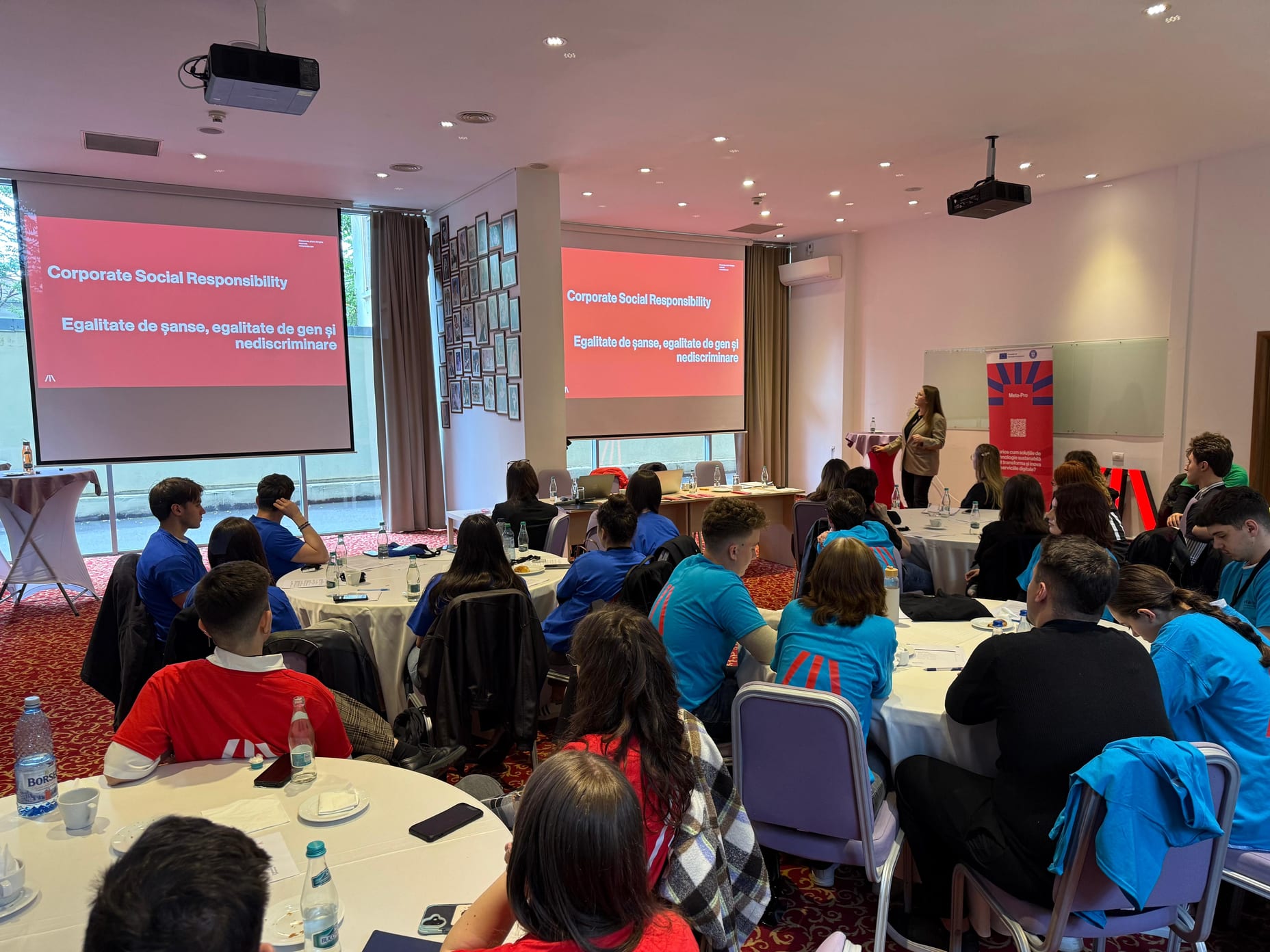
A programme funded by the European Social Fund brings industry, universities and students around the same table — an educational programme that is changing the way practice is done in Romania.
In a labour market where technologies evolve faster than any curriculum, the gap between theory and the real needs of industry is becoming ever more visible. In this context, the Meta-Pro project — developed by Metaminds and funded through the Education and Employment Programme — takes a pragmatic approach: students don’t just learn concepts, they work on real applications, with deadlines and under the guidance of industry professionals.
Over 190 students from four universities have already been through the Meta-Pro internship programme, building functional technology products: ICU-monitoring apps, logistics platforms for farmers, intermediary-free marketplaces, personalised-reading tools and AI-assisted career guidance. All were created in multidisciplinary teams, in real sprints and under direct mentorship from industry.
To understand the mechanism from the inside, we spoke with three of its main players: Ramona Bâliș, CFO and board member at Metaminds; Ovidiu Solomon, Vice-Dean of the Faculty of Cybernetics, Statistics and Economic Informatics (ASE Bucharest); and Bianca Rachieru, a third-year student and Project Manager of a Meta-Pro team.
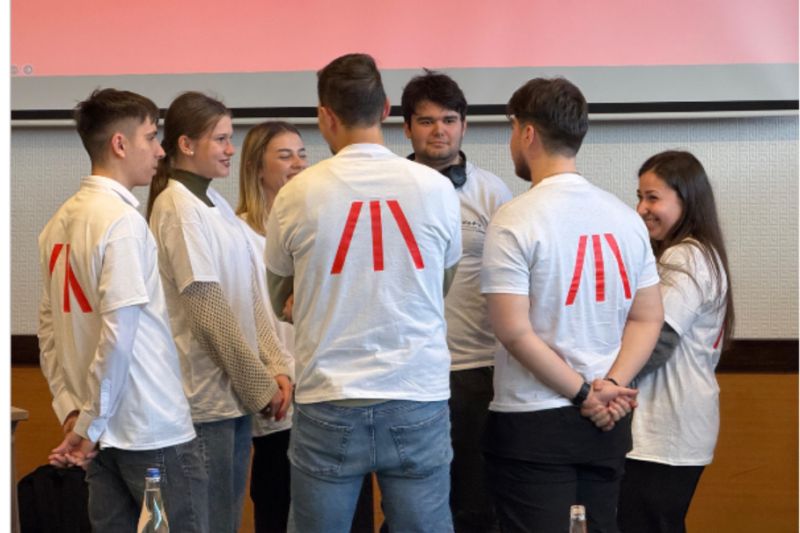
Industry — Ramona Bâliș
“Think at the pace of industry, not of semesters.”
For Ramona Bâliș, CFO and board member at Metaminds, the idea for the project didn’t arise as a theoretical exercise, but as a solution to a problem seen constantly in recruitment. In recent years, she says, the gap between the knowledge gained during university and the skills needed to actually land a job has become ever more obvious. Universities provide the foundation, while technology, ways of working and the dynamics of industry change faster than the academic semester.
It was out of exactly this need that the Meta-Pro internship programme took shape — a framework in which students work on real projects, with real deliverables, clearly defined roles and direct mentorship from industry. Universities saw an opportunity in it: not just to modernise their practice, but to constantly integrate recommendations from industry into their own programmes.
What did the universities see in this project that convinced them to get involved?
They saw exactly what we saw: an opportunity to do things differently. The Bucharest University of Economic Studies, for example, has a tradition of training economics specialists, but the market has changed. It is no longer enough to master the theory — you have to understand how a project runs at the real pace of industry, how you communicate with a client and how you handle critical situations under the pressure of deadlines. We came to them with concrete resources — industry mentors, ESF funding, infrastructure — and with a clear model: students would experience the conditions of a real job while still enjoying the safety of the educational environment.
What was the biggest challenge so far, and how did you handle it?
Convincing everyone to think at the pace of industry, not of academic semesters! The logistics designed and run by the Meta-Pro mentors were complex — coordinating 64 students, grouped into four series running simultaneously, alongside mentors who were also busy with their own day-to-day professional work. In total, the Meta-Pro programme involved 194 students from renowned Romanian universities — the Bucharest University of Economic Studies, the Politehnica University of Bucharest, the Transilvania University of Brașov and the Lucian Blaga University of Sibiu. It was like conducting several symphonies with a single conductor. But we learned to be agile — literally. We introduced short daily stand-ups, retrospectives and weekly progress reviews. In practice, we treated the programme like a real tech product.
Can you give us a concrete example of success?
Certainly — we have many, and we’re delighted about it. One team built an app that connects local producers directly with consumers — an intermediary-free marketplace for authentic Romanian products. They started from a simple university idea about sustainability and the circular economy, turned it into a working web and mobile platform with integrated payments and logistics, and it’s already in testing with real producers around Bucharest. Two team members received job offers from e-commerce companies before finishing their degrees. That’s the impact we were looking for.
Participants are selected not on grades but on attitude: curiosity, motivation, the willingness to work in a team. Assessment is continuous and based on deliverables, exactly as in a real organisation. And Ramona Bâliș’s message to other companies wanting to build similar programmes stays simple: the focus has to be on impact, not on statistics.
Academia — Ovidiu Solomon, Vice-Dean of ASE
“We felt the need to accelerate the practical component.”
If in industry Meta-Pro fills a practical gap, in the university world the programme acts as a catalyst for change. For faculties, working with Metaminds isn’t just a partnership but a new learning infrastructure — one that connects the curriculum with the reality of the market, provides access to industry mentors, and turns practice into an applied exercise rather than a formality. We wanted to understand how academia sees this model, and spoke with Ovidiu Solomon, Vice-Dean of ASE’s Faculty of Cybernetics, Statistics and Economic Informatics (CSIE).
Why did CSIE choose to get involved in Meta-Pro?
Because we saw in it an opportunity to complete our portfolio of partnerships with a collaboration from which all parties, especially the students, stand to gain. Our faculty has been training IT and economics specialists for decades, but we felt the need to accelerate the practical component. Meta-Pro gave us exactly that — a structure through which students can experience “real life” while still studying. The funding provided through the European Social Fund made it possible for this practical training, carried out alongside industry specialists, to be accessible to students from less-developed regions too, increasing equality of opportunity.
How does Meta-Pro fit into the faculty’s wider strategy?
Very well. Our goal is to prepare graduates who not only meet hiring requirements but become the ideal candidates for the companies they apply to. Meta-Pro adds a practical, applied and entrepreneurial dimension to the university programme. It also helps us stay in touch with industry: mentors from the partner companies constantly give us feedback on which skills are in demand, so we can adjust course content accordingly.
How do you balance research and practice?
The balance between research and practice is one of the secrets of professional success. I believe they cannot be separated. Given how fast the IT sector evolves, research is the foundation for finding innovative solutions. The theoretical side offers a narrow field of work, which practice can easily broaden. In short, in our field, research and practice are in symbiosis.
What message do you have for students?
Be convinced that there is a place for everyone in this field. But also be aware that for that you have to commit, always keep up with what is happening in your field and in adjacent ones, get involved and step out of your comfort zone.
Student — Bianca Rachieru
“I learned a great deal about leadership in six months of Meta-Pro.”
If industry provides the expertise and universities create the framework, the true measure of Meta-Pro shows in the students’ experience — those who move, perhaps for the first time, from theory to real responsibility. We spoke with Bianca R., Project Manager of a Meta-Pro team and a student at ASE’s CSIE, to understand what that transformation looks like from the inside.
How did you end up in Meta-Pro, and why?
Honestly, at first I was sceptical. I saw the announcement on the faculty group and thought, “another fancy programme with lots of slides and little practice.” But I applied because they promised we’d work with real technologies — React, Node.js, cloud infrastructure. I solved a coding challenge, had an interview and was accepted, and what followed fascinated me.
What does it mean to be a Project Manager in a student team on a real project?
It means learning real management: of time, of resources, of emotions! Joking aside, it’s a big responsibility. I have to coordinate five colleagues, keep in touch with our industry mentor, meet deadlines and make sure everyone contributes. Meta-Pro taught me that leadership isn’t only about organisation: it’s about empathy, balance and how to turn different opinions into ideas that push the project forward. It was challenging, but also one of the best experiences I’ve had.
What are you building, and where are you with it?
We’re building an app that lets customers buy directly from local producers — farmers, craftspeople or artisan cheesemakers, with no intermediaries. The backend is already working; we have the database, secure authentication and the ordering system. Now we’re focusing on the mobile interface and integrating a payment processor so everything is as simple and intuitive as possible.
What did you learn about teamwork?
It’s completely different from university projects, where you split up the tasks and just give the impression of working together. Here you really have to sync — we have daily stand-ups at 9 a.m., we work in Git, review each other’s code and track everything on a shared board where progress is clearly visible. I also learned that it’s okay to ask for help. There was a moment when I wasn’t sure how to prioritise a critical task; I talked it through with the team, we decided together on the best approach and moved on. As a Project Manager, I realised how important it is to stay calm, make decisions together with the team and be real support for every member.
How did this experience change you?
It made me understand what it really means to be part of the world of technology. It’s not just about lines of code, but about understanding real people and their problems. I remember the first interview with a cheesemaker from Brașov, telling us how he loses almost a third of his profit to intermediaries. In that moment I realised that what we’re building isn’t just an app, but a solution that can change something concrete for small producers. Since then I’ve applied to three internships. At every interview, when I showed our app and explained how we connect producers directly with consumers, I saw the reaction immediately — interest, curiosity, enthusiasm. One recruiter even told me: “We spend months preparing juniors to understand business logic and user experience — you’ve already been through that in Meta-Pro.”
What advice do you have for other students thinking of applying?
If I had one piece of advice, it would be this: take the step! You don’t have to know everything, you just need the courage to start. Yes, it’s a lot of work, but it’s the kind of effort that changes you. Here every day counts — if you don’t deliver, the team feels it, and only then do you truly learn what responsibility and teamwork mean. The experience brings you close to the reality of industry: pace, pressure, satisfaction. It challenges you to make mistakes, correct them and grow. And perhaps most importantly, it helps you understand whether technology is really for you. Finding that out in your second or third year is a real chance for your future career.
How do you see your future after Meta-Pro?
I feel confident. I have solid skills, a real portfolio and an app that solves a concrete problem. But what matters most is the community I’ve gained — the mentors have become people in my professional network, whom I can turn to any time. The most unexpected thing was discovering that I enjoy not only writing code but coordinating the development of a product, especially in e-commerce and marketplaces. Maybe in a few years I’ll work as a product owner in a social-impact startup or a circular-economy platform. Meta-Pro didn’t just open doors for me, but horizons I hadn’t even considered.
About Meta-Pro
Meta-Pro shows that partnerships between academia and industry can work when there is a shared vision and real involvement from both sides. Students gain practical skills and confidence, universities become more relevant to the labour market, and companies get access to young professionals who are already trained. The programme continues in the coming series, with plans to expand to other faculties and fields. For students, the message is clear: the opportunities are there — it only remains to take the step towards them.
Meta-Pro is a project funded through the European Social Fund, implemented by Metaminds in partnership with universities across Romania to develop students’ digital and entrepreneurial skills.
See the Meta-Pro programme →