Solutions/Quality Engineering
Engineering discipline·Review to day two
Architecture reviewed,
tested and validated before production.
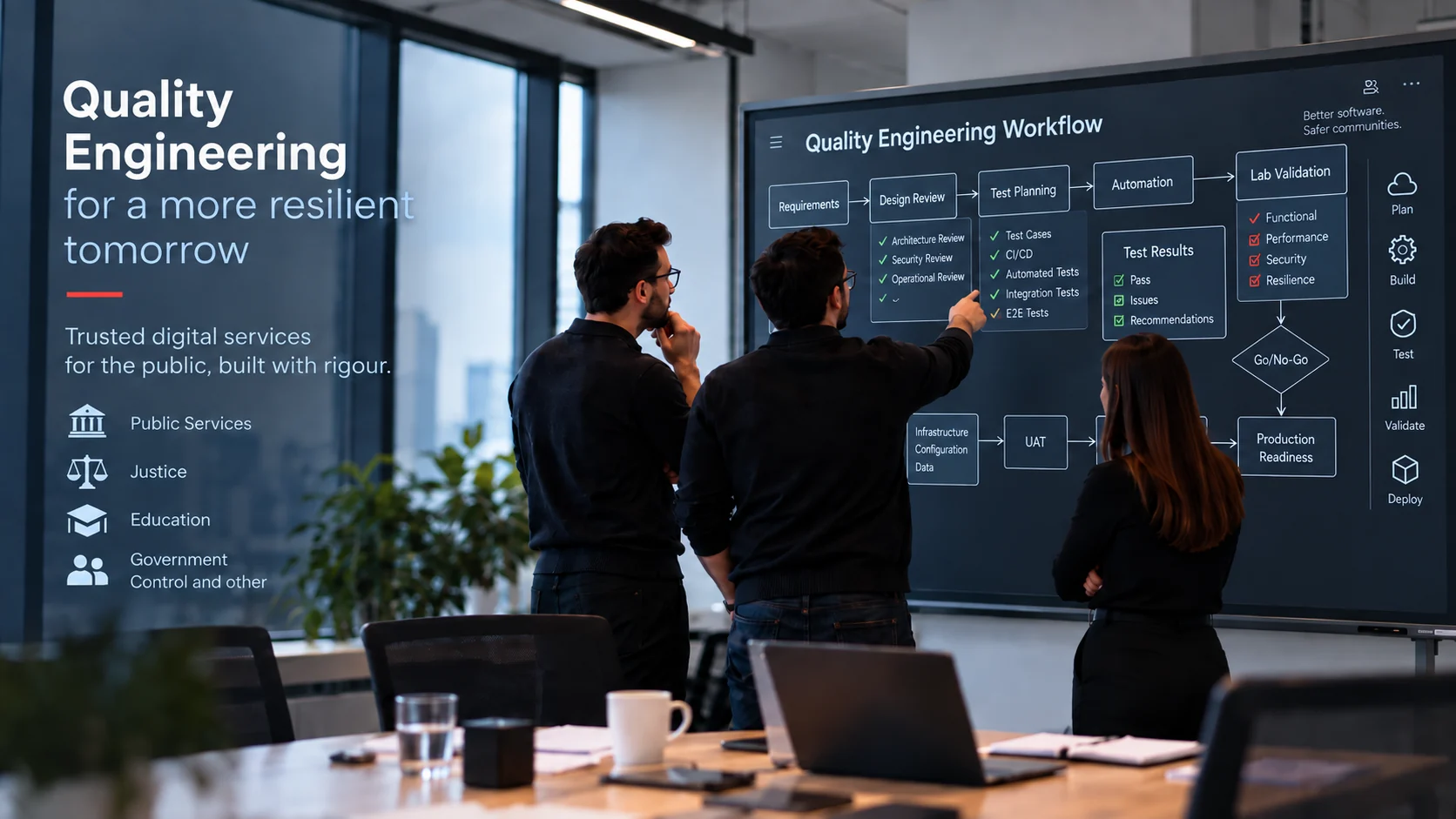
Design review, automated verification and lab validation ahead of national rollout — technology proven in a lab, not on citizens.
01Our commitment
Excellence is not a milestone.
It is the standard we hold on every delivery.
The platforms we build carry tax filings, court hearings, school networks and government communications. On systems like these a defect is not a line in a backlog — it is a citizen who cannot file, a hearing that cannot proceed, a public service that is not there on the day it is needed most.
So we pursue excellence in delivery and in operations as one continuous discipline, not two separate phases. It begins at the first architecture review and it does not end at go-live: we design for the load of the worst day rather than the average one, we prove technology in our own lab before it touches a client estate, and we stay with the programme afterwards — because a system is only ever as good as the way it is run.
And we put our clients' needs ahead of our own preferences: the right architecture for the mission rather than the most convenient one, independent advice on technology choices, and documentation and training that leave client teams genuinely able to operate what we have built. Progress is a long-term commitment. So is the quality of the systems that carry it.
02Overview
On critical systems,
defects are not tickets.
Quality is often reduced to functional testing at the end of a project, when architectural decisions can no longer be changed. We apply best practice in architecture design as an engineering discipline — reviewed early, verified continuously, and validated against the real conditions the system will meet.
03Services
Five practices,
applied from design to day two.
Architecture review
Design assessment against resilience, security and operability criteria — carried out while the design can still change, and recorded as decisions rather than opinions.
Test automation
Verification wired into GitLab pipelines: contract, integration, performance and security gates that a release must pass before it can progress.
Performance & load validation
Peak-day simulation — electoral load, tax deadlines, exam periods — so capacity is proven against the worst day, not an average one.
Technology validation
New platforms proven in the innovation lab before entering a client estate, with the integration risks found in our environment rather than theirs.
Standards & documentation
Reference architectures and operating standards that scale across programmes, so the second delivery starts from what the first one proved.
04How we work
Four gates between a design
and a system we will stand behind.
Each gate is a stage in one delivery chain, not a separate exercise. Work that has not cleared the gate behind it does not move on — and what operations learn, along with what the lab proves, returns to the design gate instead of being written off as experience.

05Methodologies
How the work is run,
not only how it is built.
Technology changes from one programme to the next; the way the work is run does not. These are the methods behind the delivery — how scope is agreed, how a team keeps its rhythm, how a change reaches production, and how a service is run once it is there. The workflow below shows which discipline is doing what, in which phase.

Project & programme management
Scope agreed in writing, a plan with dates that someone owns, and a forum where a decision can actually be taken rather than deferred — iterative or staged, whichever the programme needs.
Delivery & engagement
How a programme starts and how it lands: what the client needs, in their words, turned into something a team can build, accept and operate.
Engineering practice
The habits that keep a codebase reviewable and a decision retrievable two years after the person who made it has moved on.
DevOps & SRE
Delivery treated as an engineered system in its own right: repeatable, reversible, and observable from the very first deployment.
Service management
What happens after go-live, written down before go-live — so the first incident is handled by a process rather than by whoever answers.
Security & compliance by design
Controls designed in at the first review, evidenced continuously through delivery, and auditable on request rather than reconstructed later.
06End to end
One programme,
from mobilisation to steady state.
The gates say what must be true before work moves on; the methods say how the work is run. This is the shape of the programme itself — the ten stages a delivery passes through, and what has to be finished at each one before the next begins.
07Technology validation
Proven in a lab,
not on citizens.
Metaminds runs an innovation lab where new technologies are permanently tested and validated. A platform earns its place in a client estate only after it has been built, broken and rebuilt in our own environment — with the integration risk absorbed by us rather than discovered by a public institution in production.
08Where it is proven
Programmes that were
validated before they went live.
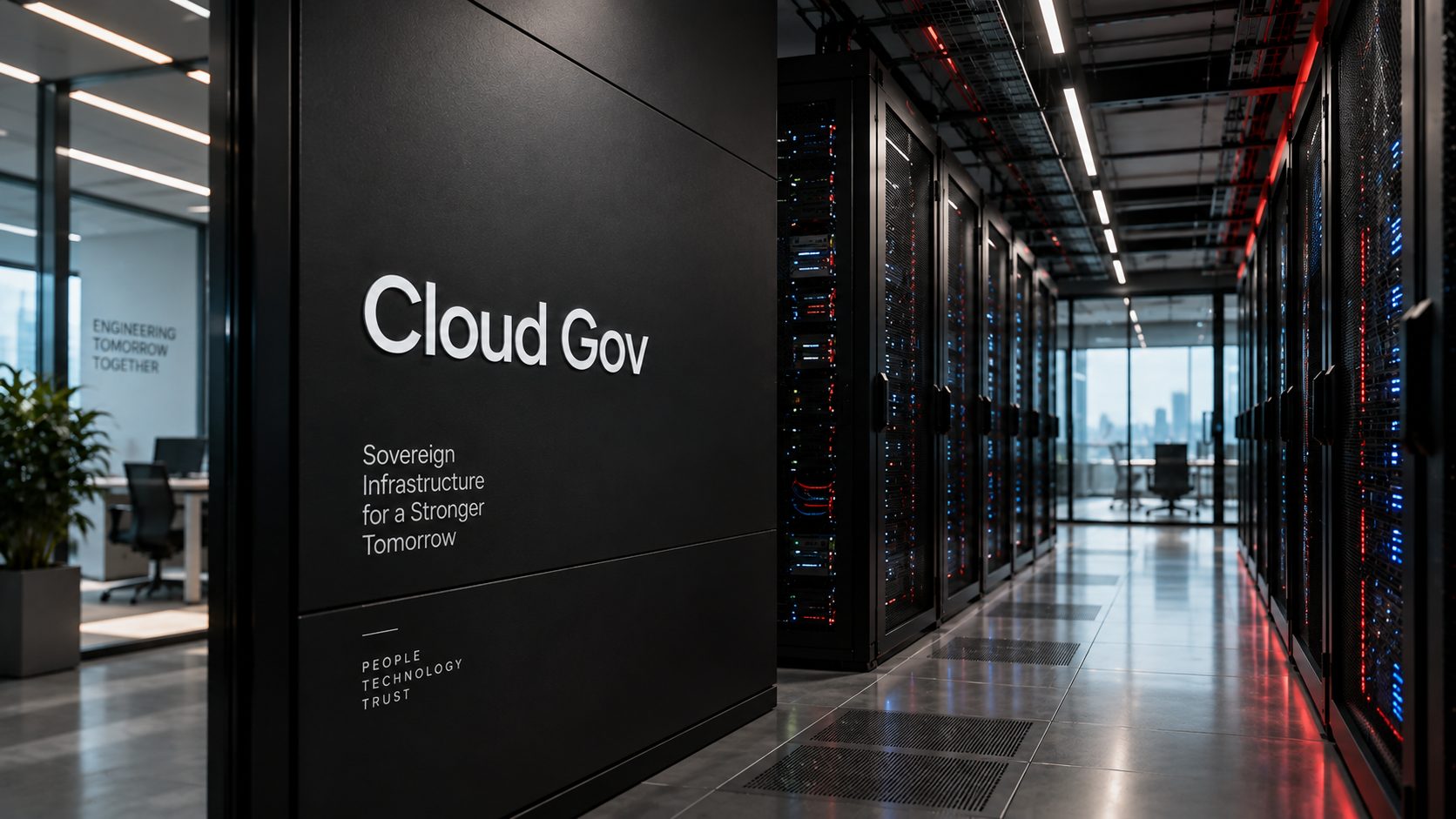
Government Cloud
A sovereign private cloud for the Romanian public sector — over 500 servers across four national data centres, built end to end on Red Hat OpenShift and OpenStack, with automated CI/CD for the applications that run on it.
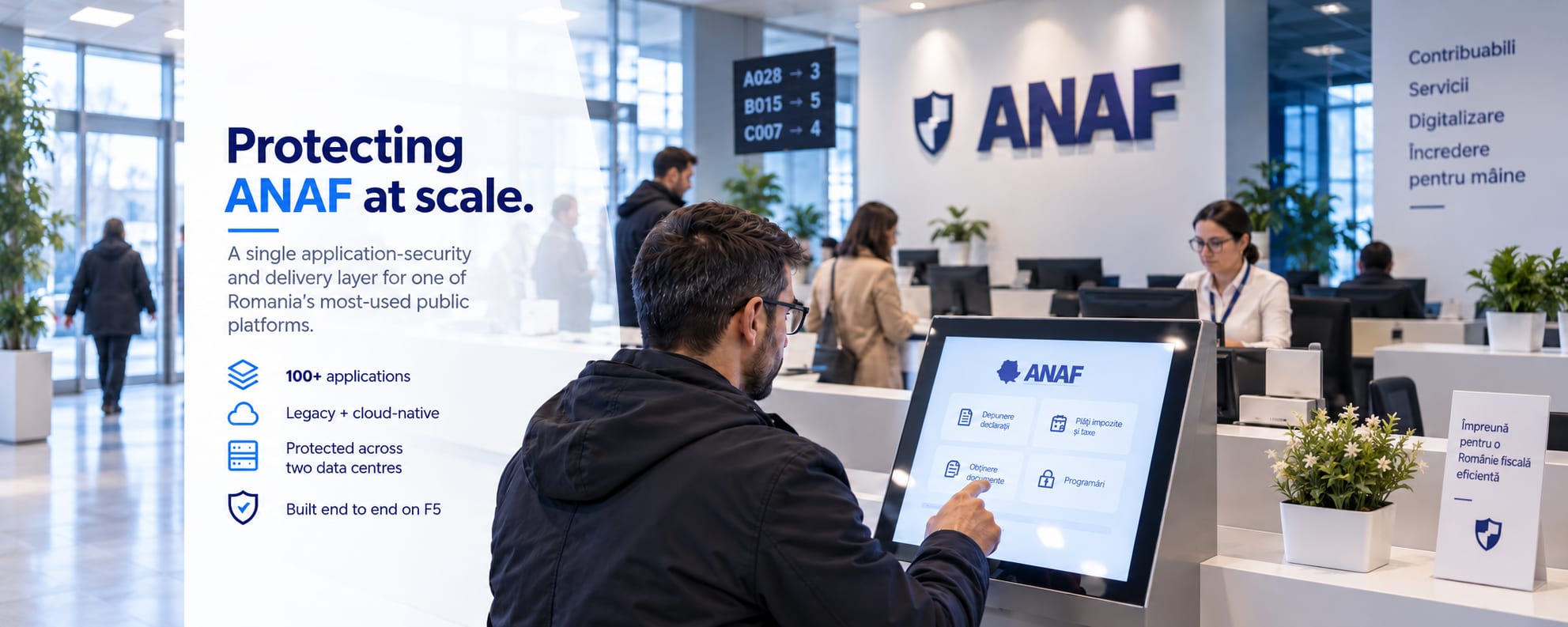
Protecting applications at scale.
The SPV platform and electronic archive: 150,000+ users, 500,000 accesses a day, 150 million files migrated, and over 100 applications protected across two data centres.