Solutions/Cloud
Cloud & Platform Engineering,
at national scale.
We build cloud-native platforms based on virtualisation, containerisation and CI/CD automation, running as IaaS and PaaS — on-premises, hybrid or multi-site.
Overview
Legacy infrastructure can no longer
keep up with digital services.
We redesign and extend the digital infrastructure of organisations using high-performance hardware and software-defined technologies, for security, performance and operational continuity — including in hybrid or multi-site environments.
Services
Cloud architecture & migration
Assessment, design and controlled migration to cloud-native architectures.
Kubernetes & container platforms
OpenShift/Kubernetes platforms with multi-tenancy, quotas and security policies.
CI/CD
End-to-end pipelines: build, test, artifact signing and continuous delivery.
Infrastructure as Code
Declarative, reproducible and auditable provisioning across the estate.
Cloud cost optimisation
Right-sizing, consumption monitoring and continuous optimisation.
IaaS / PaaS
Infrastructure and platform services delivered as an internal product.
Architecture
we use
Full stack → Platform engineering is the discipline of designing, building and running an Internal Developer Platform as a product: a curated, self-service paved road that lets application teams ship software quickly and safely, while the platform team owns the complexity underneath — consistently, and as code.
↓ Intent flows down — declared in Git ↑ Feedback flows up — status, metrics, insights
Developers shipping services on the golden path
Self-service onboarding, quotas, access
Evolve the platform through the same GitOps path
Catalog-grounded, least-privilege, acting via Git
One place to find, create and understand services
Versioned, pinned and nudged; one path first, then widen
Developers declare intent, not infrastructure
Tenant → Project → Service, minutes not tickets
Read-only, answers from the catalog
Canonical model: Platform · Site · Cluster · Tenant · Project · Service
All intent versioned, reviewed, auditable; rollback = revert
Intent rendered to manifests, continuously converged per site
Admission, naming, signatures — guardrails, not gates
Roles = capability, groups = scope; humans and machines
DORA, adoption, time-to-first-deploy, NPS
Build, scan, sign, attest (SLSA)
GitOps deploys, progressive rollout gated on SLOs
Infrastructure and resources as declarative APIs
Ingress, WAF, mesh, global traffic steering
Metrics, traces, logs — available everywhere
Runtime detection, scanning, secret references only
Managed databases with tiered DR
One distribution, every cluster, every site
Management · Production · Development (Active/Standby); Observability · Logging (Active/Active)
Health-checked failover between sites
Sovereign, no public-cloud dependency
Operating model
The platform is a product
Success is measured, not assumed: baseline first, then relative targets.
Design principles
How the platform behaves
Cognitive load moves from every developer to one platform team — once.
Why it matters
Outcomes
Faster delivery
Time-to-first-deploy in hours; shorter lead time for changes.
Lower cognitive load
Teams focus on their product, not on Kubernetes, networking or PKI.
Secure & compliant by default
Signed, scanned, policy-checked artefacts; a full audit trail in Git.
Sovereign & cost-controlled
An open-source stack, owned and operated in-house, on our own infrastructure.
Case
studies

Government Cloud
A sovereign private cloud for the Romanian public sector — over 500 servers across four Tier IV data centres, built end to end on Red Hat OpenShift and OpenStack.
Email centralisation
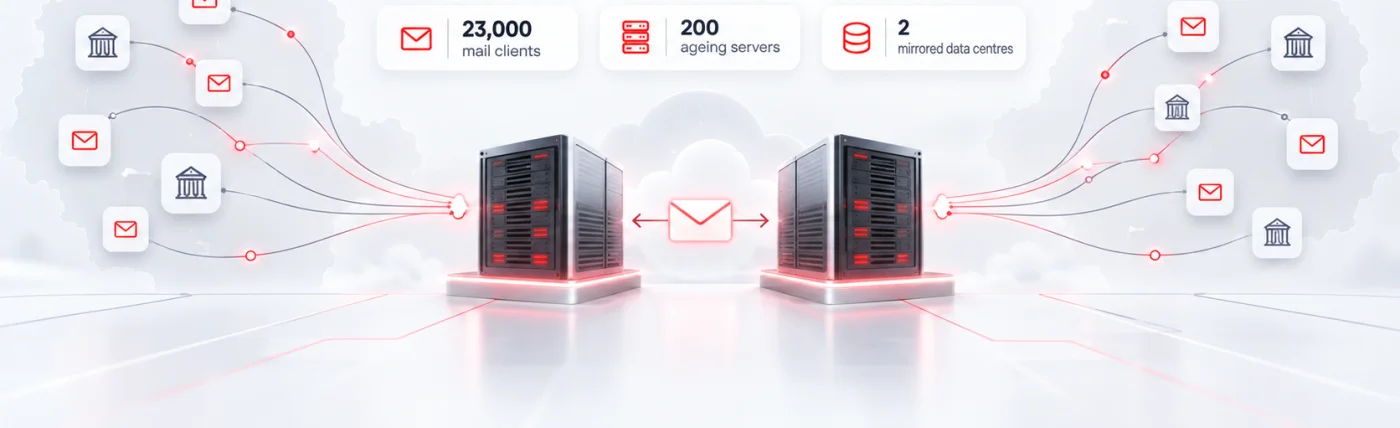
Roughly 200 ageing regional servers, 23,000 mail clients and 100+ business applications consolidated onto two mirrored data centres — without re-engineering a single application.