Case studies/Email centralisation
Public sector · Consolidation & business continuity · Romania
Email Centralisation
Two hundred ageing servers across the country, 23,000 mail clients and more than a hundred business applications — consolidated onto two mirrored data centres without re-engineering a single application.

01The challenge
A decade-old estate that could not simply be replaced
The institution’s electronic messaging platform had grown into roughly two hundred servers spread across central and regional sites, running on hardware at least ten years old. Maintenance contracts had lapsed, failures were frequent, and some of those failures were losing data.
Replacing the platform outright was never the cheaper option: more than a hundred business applications sat on the same technology, several of them critical to how the institution runs. The mandate was to consolidate the estate onto new, reliable infrastructure — and to leave the applications untouched.
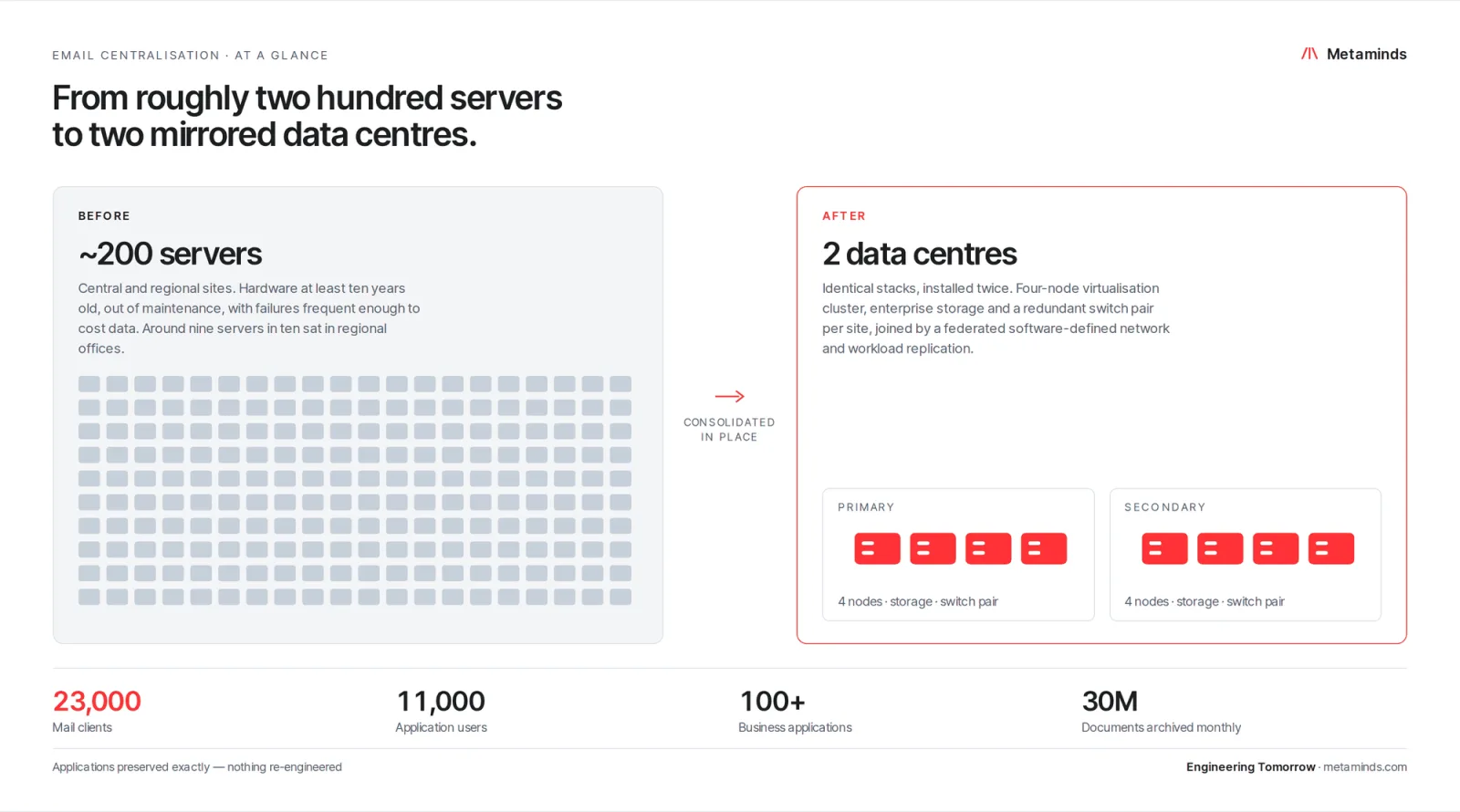
The estate before and after consolidation, with the scale it had to keep carrying.
02Scale
What sat on the old estate,
and had to keep working.
Beyond mail, the platform carried the institution’s document-management system, declaration transfer to other national bodies, contact and petition handling, appeals, decisions, helpdesk and asset declarations — used by around 11,000 internal staff and, indirectly, by every citizen and business filing through the public portal. Roughly nine servers in ten were regional, and those were the ones being retired.
03What was delivered
One solution, installed twice
Compute, storage, network, virtualisation, software-defined networking and replication were delivered as a single stack — and installed identically in both data centres, so neither site is the poor relation.
Two identical clusters of current-generation two-socket rack servers, one in each data centre, replacing regional hardware that was a decade past its service life. Redundant boot volumes, out-of-band management on every node, and 25 Gbps interfaces throughout.
A high-end enterprise storage array at each site, dual-fabric attached over fibre channel with independent front-end port groups, so no single fabric, port or director interrupts access. Capacity is presented to the clusters as two 50 TB datastores per site.
A pair of data-centre switches at each site forms the interconnection layer between the core network and the servers, configured as a virtual port-channel pair so either switch can fail without dropping a link, with aggregated uplinks from every host.
Both clusters run current-generation vSphere with high availability and dynamic resource scheduling enabled, so virtual machines are distributed evenly across nodes and restarted automatically if a node is lost. Management, live-migration and overlay traffic are separated onto dedicated interfaces.
Distributed routing, distributed layer-2 and a distributed firewall are delivered by a federated SDN: a local manager cluster in each data centre, and a single global manager — active at the primary site, standby at the secondary — so all global routing and security policy is configured once and pushed to both sites.
An advanced load-balancer control cluster in each data centre drives service engines inside the software-defined estate, integrated with the local network manager. A container platform runs at the primary site for modernised workloads.
04Architecture
A federated estate across two sites
The diagram shows the reference architecture model — not the actual internal implementation. A single global control plane governs both data centres; each site runs its own local managers, edge cluster, virtualisation cluster, storage and switch pair, and the two are joined by a stretched overlay and by workload replication.

05Federation
Why federate the network
Two data centres configured independently drift apart. Federating the software-defined network makes one policy plane authoritative for both.
06Continuity
Continuity, at three different scales
A disk, a host, a whole site — each failure is absorbed by a different mechanism, and none of them requires the applications to know.
07Outcome
What consolidation actually buys
Availability
Redundancy at every layer — power, fabric, switch, host, array and site — with automatic restart inside a site and replication between sites.
Data protection
Enterprise storage with redundant paths, plus consistent, grouped replication of protected workloads to the second data centre.
Lower running cost
Retiring the regional server estate removes the maintenance contracts, the spare parts and the electricity that went with roughly nine servers in ten.
Less administrative effort
One consolidated estate, one federated policy plane and one set of managed clusters, instead of a change repeated across hundreds of machines.
08Confidentiality note
We do not disclose the client, specific locations, addressing, host naming or the actual internal technology architecture of the project.
The diagram and figures on this page describe the reference architecture model and the publicly communicable scale of the engagement.