Application security & delivery — Romania
Protecting applications at scale.
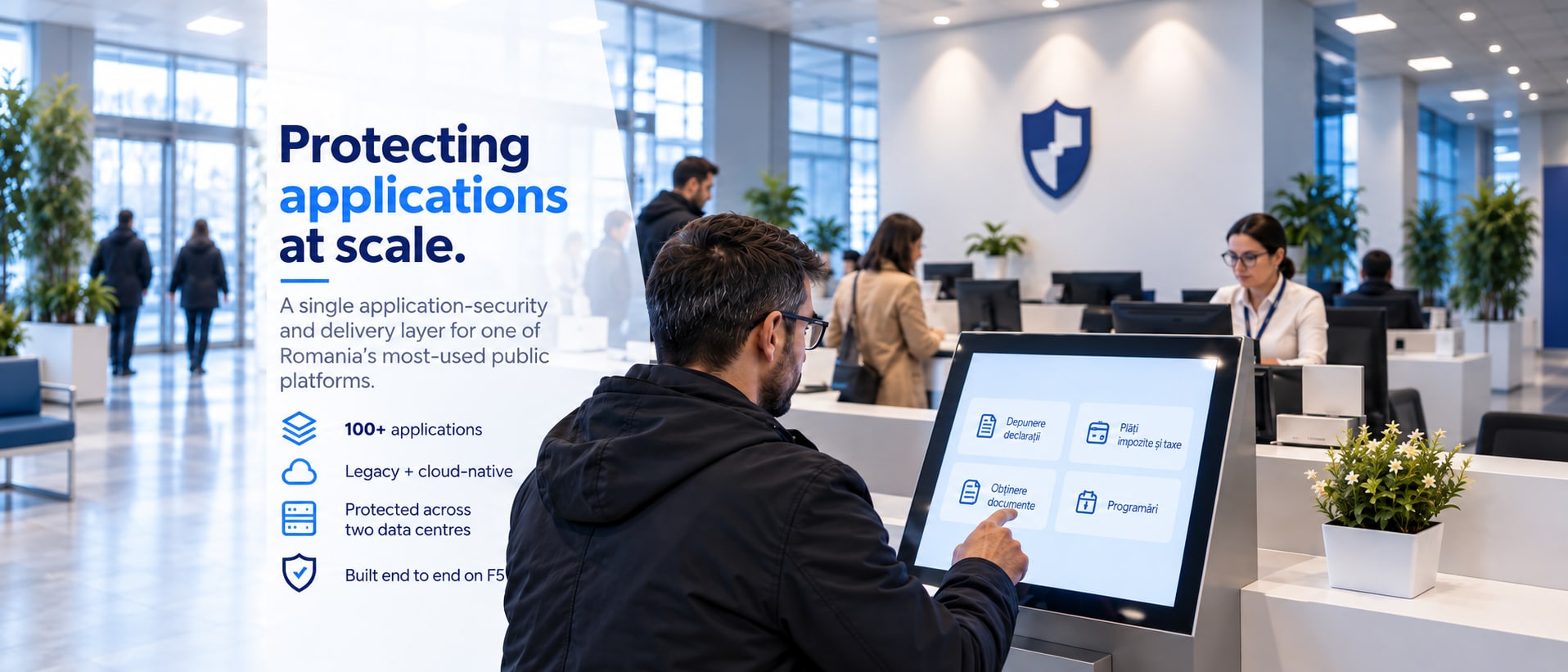
A single application-security and delivery layer for one of Romania’s most-used public platforms — 100+ legacy and cloud-native applications protected across two data centres, built end to end on F5.
protected
+ cloud
platform
01The challenge
One security layer for a mixed application estate
ANAF’s citizen-facing services run on a mixed estate — established legacy applications alongside modern, cloud-native workloads on Kubernetes. Both are exposed to the public at scale, and both are under continuous attack.
The mandate was a single application-security and delivery layer that protects everything, old and new, without rebuilding the applications behind it. Four constraints shaped every decision.
02Scale
Public-facing services,
under constant attack.
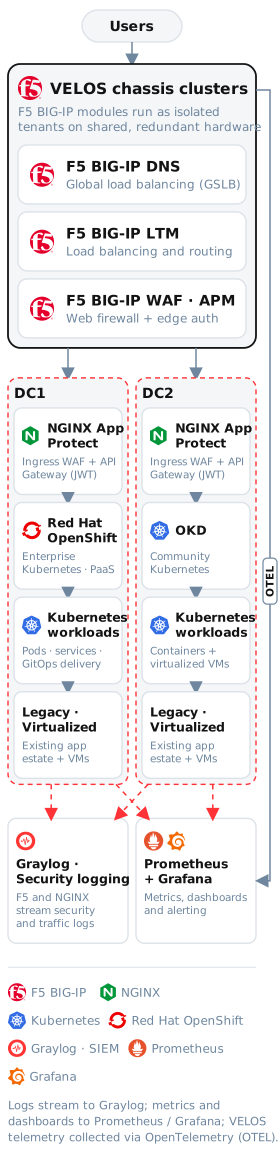
Traffic is steered to the healthy site by global load balancing, inspected by the web application firewall, and routed to legacy or cloud-native backends across two data centres.
03The F5 platform
Five F5 modules, one delivery and security layer
The entire application-security and delivery layer is F5 — one vendor from the global load balancer to the Kubernetes ingress, a single control and support chain for services that cannot go down.
Signature- and behaviour-based protection for every published application; the layer that turns back roughly 1.5 million attacks a day before they reach an app.
Load balancing and application routing across the server pools at each site, for both legacy and containerised backends.
Authentication and access control at the edge, integrated with the identity layer.
Directs users to the healthy data centre and fails traffic over between DC1 and DC2.
API Gateway with JWT validation and NGINX Ingress Controller with App Protect in front of the Kubernetes clusters; governed through NGINX Management Suite and a Developer Portal.
04Architecture
One reference model, mirrored across two sites
The diagram shows the reference architecture model — not the actual internal implementation. Traffic enters through F5 DNS, is balanced by LTM, inspected by the WAF and NGINX App Protect, and routed through the NGINX API gateway and ingress into the Kubernetes clusters, legacy servers and virtualized infrastructure across both sites.
05Substrate
From VIPRION to VELOS
All F5 modules were consolidated onto VELOS — F5’s chassis platform running on F5OS — replacing the previous VIPRION estate. Each BIG-IP instance runs as an isolated tenant on shared, redundant hardware.
06Integrations
Security logging, identity and API management
The platform is wired into the wider operations stack.
07Confidentiality note
We do not disclose specific names, locations, or the actual internal technology architecture of the project.
The diagram and figures on this page describe the reference architecture model and the publicly communicable scale of the engagement.