Case studyPublic sector · Education — Romania
WiFi Campus
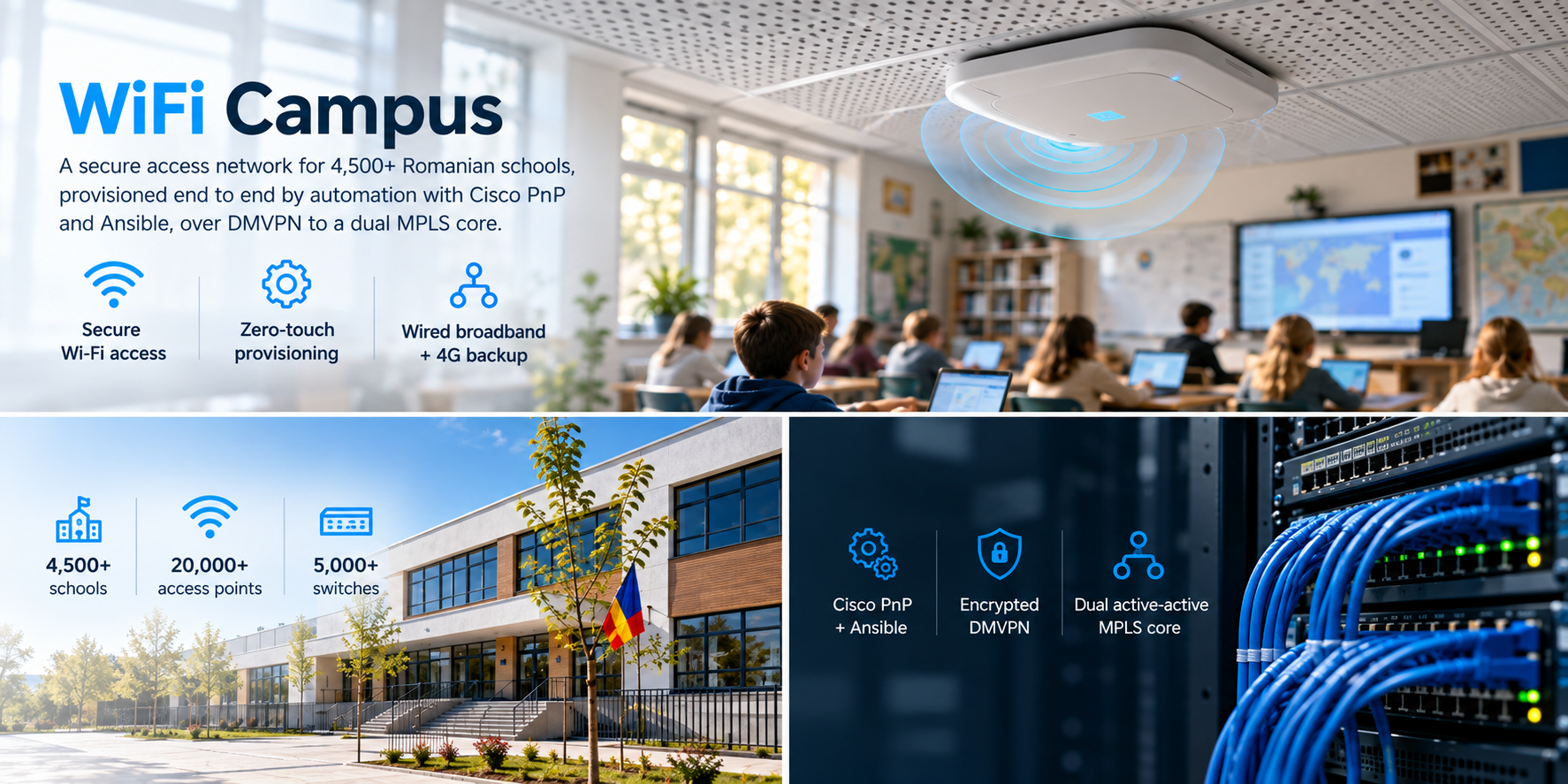
Secure, managed WiFi delivered to thousands of Romanian schools at once — a nationwide access network provisioned end to end by automation, with engineers watching a Slack channel instead of driving a console.
01The challenge
Connect a nation’s schools —
faster than hands can configure.
Thousands of schools, spread across every county, each needing the same secure, segregated, centrally managed WiFi — and each with only a broadband line and no on-site network engineer. Delivering that estate by hand, device by device, was never going to finish.
So it wasn’t delivered by hand. This was Metaminds’ first deployment built entirely on automation: routers, switches and access points that provision themselves the moment they are powered on and reach the Internet.
02Scale of the project
A national access network,
provisioned without hands.
In partnership with BlackBerry, WiFi Campus became the largest BlackBerry deployment in Europe — the network behind a smart-education programme reaching Romanian schools nationwide.
03Zero-touch automation
Every device provisions itself. Engineers just watch Slack.
The whole estate was built with Cisco Plug and Play and Ansible: configuration generated per school from one source of truth, delivered to devices that call home on first boot. No golden image copied by hand, no per-site console work.
The result: routers, switches and access points across thousands of sites brought online in fully automated mode, without human intervention — a scale of hands-off rollout Metaminds had not attempted before, and the template for everything since.
04Network architecture
Three tiers: access, distribution, core
The model below is the reference architecture, not the actual implementation. Schools reach four regional distribution centres over encrypted DMVPN tunnels; the distribution tier hands off to a dual active-active MPLS core that fronts the Internet and the national research-and-education network.
Edge router with an on-board compute module; dual WAN.
Wired broadband primary + 4G LTE secondary.
8-port PoE switching, one or more per school.
Wireless coverage sized to the building.
Every school-to-distribution tunnel encrypted end to end.
Each region terminates on two distribution routers in different centres.
Wired path to the primary hub, 4G path to the secondary.
Management and user planes carried in their own VRFs.
DMVPN hubs, primary/secondary per region.
Next-gen firewall cluster at every distribution site.
Layer-2 aggregation to the core.
DHCP / DNS / IPAM cluster serving the region.
Active-active core routers, 40G aggregated links.
MPLS-VPN backbone with route-reflected MP-BGP.
CGNAT for Internet access across the estate.
Firewall clusters guarding the core.
05Security & IP management
Guarded at every tier, addressed from one system
06The rollout
Two core sites, four regions,
one Slack channel.
The backbone was built as two active-active core sites — both fronting the Internet with Carrier-Grade NAT — and four regional distribution centres, each carrying the DMVPN hubs, firewalls and addressing for its region.
Against that backbone, sites were turned up continuously and automatically. Progress lived in Slack: a location lit up as its devices registered, and closed itself once they were all online — leaving the team free to chase only what didn’t.
07Confidentiality note
We do not disclose specific locations, addressing, or the actual internal configuration of the project.
The figures and the architecture on this page describe the reference model and the publicly communicable scale of the engagement.