Projects/ANAF Back-up
Public sector·Tax administration·Backup, archive & recovery
Every filing the country makes,
recoverable from two data centres.
A backup and restore platform for the National Tax Administration Agency estate — built twice, in two national data centres two hundred kilometres apart, and accepted only after every class of system had been backed up and restored in front of the client.
01The mandate
A tax administration cannot lose a document.
Not one, not ever.
The estate behind Romanian tax administration is not a modern greenfield platform. It is thirty years of accumulated public service: partitioned enterprise servers, database estates that predate the cloud era, several virtualisation platforms running side by side, an enterprise messaging system, and an electronic archive that has been accepting citizens' documents continuously since 2009.
All of it has to be recoverable — more than eight hundred terabytes of live data, and an archive of over 150 million documents. A declaration filed through the public portal, a document lodged at a counter in a county tax office, a database that clears payments: each one carries a legal obligation that does not soften because the system holding it is fifteen years old.
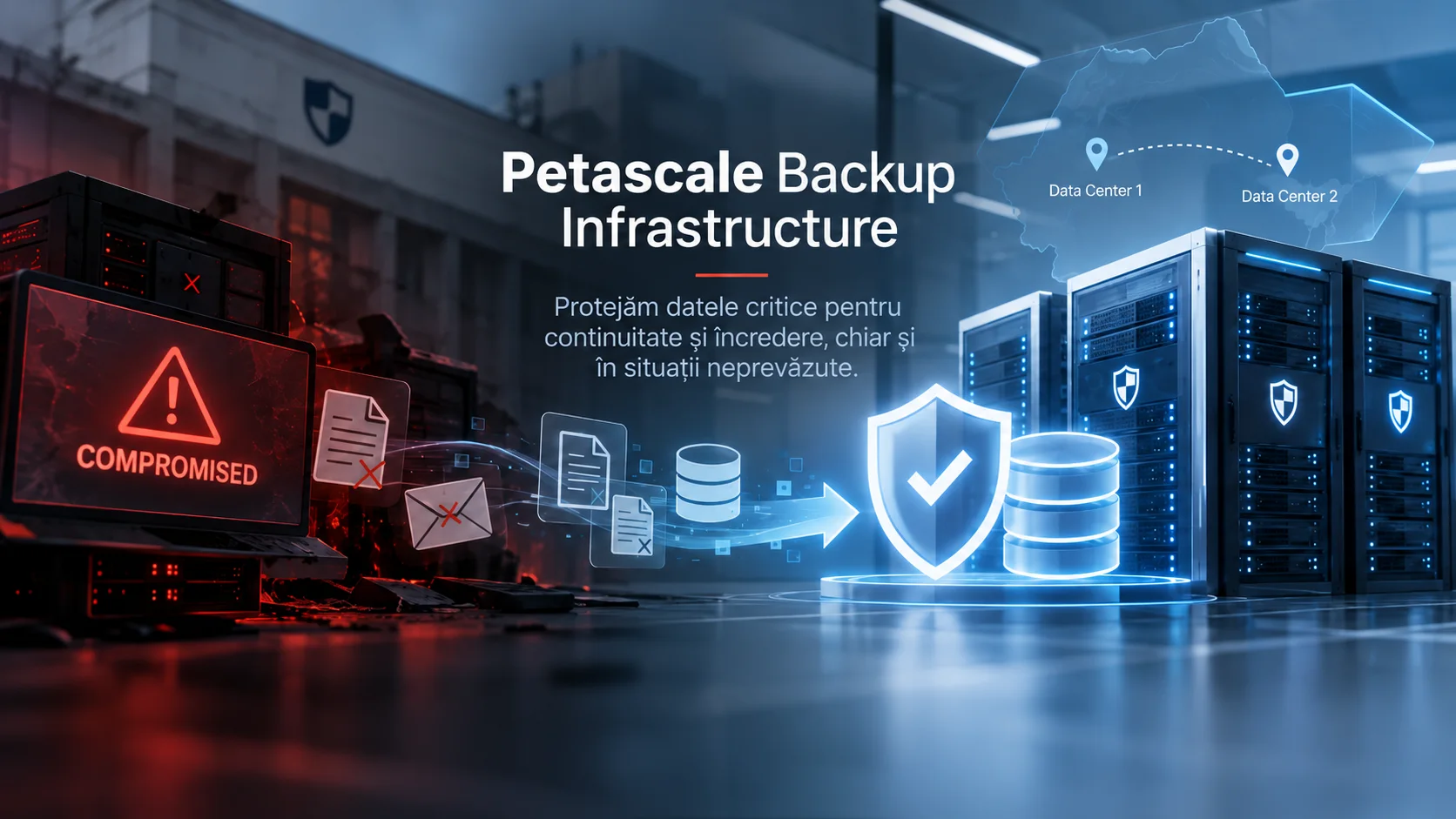
So the platform was delivered twice — a complete, independent instance in each data centre, two hundred kilometres apart, with each site holding a copy of the other's backups. Losing a site does not mean losing the ability to recover from it.
02Overview
Disk, object and tape,
under one policy engine.
Each data centre received a complete protection stack: a deduplicating disk tier holding the daily recovery point, an object tier for long-term archive with a flash cache in front of it, and a tape library for the copies that have to leave spinning disk. One policy engine drives all three, with agents installed on the protected systems themselves. Capacity was sized for three years of growth, and the existing network and storage fabrics were reused rather than replaced.
03What was delivered
Six components,
delivered identically in both data centres.
Racks & power
Three full-height enclosures per site, each on metered, dual-fed power. Draw and cooling load were calculated and declared to the client before anything was installed, then measured against the declaration.
Backup & restore platform
An enterprise data-protection suite licensed for the entire estate at each site — every processor socket and the full storage footprint allocated to servers, virtual machines, databases, messaging and file systems.
Deduplicating disk tier
The primary landing zone for every backup, on high-capacity disk with inline deduplication, sized for three years of retention and connected to both the storage and the network fabric already in the data centre.
Object archive tier
A multi-node object platform for data that has to be kept for years, behind its own redundant switching, with an all-flash array acting as the cache tier in front of it and a policy engine moving data between them.
Tape libraries
A library at each site, presented to the platform as a single logical unit, for the copies that have to leave spinning disk — including write-once media for records that must not be alterable after they are written.
Agent rollout & integration
Protection agents installed across every operating-system family in the estate, with application-aware modules for the databases, the messaging platform and each virtualisation stack, then registered, grouped and bound to policies.
04What is protected
Five classes of system,
each with its own way of being backed up.
05Services
What the work
actually involved
The contract was for a working platform, not for a delivery of boxes. That meant understanding an estate nobody had documented end to end, designing around what was already there, installing into two live data centres without interrupting them, proving the result against a plan agreed in advance, and leaving the client's own team able to run it.
Design
Turning a stated requirement into an architecture that fits the estate as it actually is — including the parts of it that are older than the products being installed.
Delivery & integration
Installation into two live national data centres, integrated with the network and storage fabrics already in place rather than alongside a second set of our own.
Proving it
Two formal test campaigns against a plan agreed before the work started, with the client choosing which systems were put through it.
Handover
A platform the client's own specialists can operate, with the documentation and the legal title to go with it.
06The solution
One platform,
built twice.
Everything running in the estate is reached by a single policy engine, every backup lands on three storage tiers with three different jobs, and the whole arrangement exists twice — once in each national data centre, with each site holding a copy of the other's backups.

07The numbers
The scale it had to hold
on the day it went live.
Databases alone account for more than a third of the protected footprint; the electronic archive, the virtualisation estate and the file systems carry most of the rest. Every figure above was measured on the delivered platform, not estimated from a datasheet.
08The hard part
Sixteen years of filings,
moved without losing one.
The electronic archive has been accepting documents since 2009, through the institution's public portal and through the counters of county tax offices — over 150 million of them, growing by around three million a month. Most of its older content sat on magnetic tape: safe, but slow to reach and tied to media that was ageing. Moving it onto the new disk platform was the part of the programme with the least margin for error.
09How it was accepted
Two test campaigns,
run against a plan agreed in advance.
Infrastructure verification
Every delivered component inventoried through its own management interface — capacity, connectivity and the health of controllers, power supplies and cooling modules — then tested for redundancy by disconnecting one power feed and one of each type of data path at a time, and confirming the platform stayed up.
Backup and restore procedures
For each class of system, in each data centre: confirm the agent is installed, confirm the system appears as a client, confirm the disk and tape targets are registered as devices, run a backup to completion without errors, verify the data landed on both disk and tape, then run a restore to completion.
The client chose the systems
The test plan did not name the partitions, virtual machines or databases to be tested. It specified that a relevant system be selected by the client for each scenario — so acceptance was never demonstrated on a system picked because it was convenient.