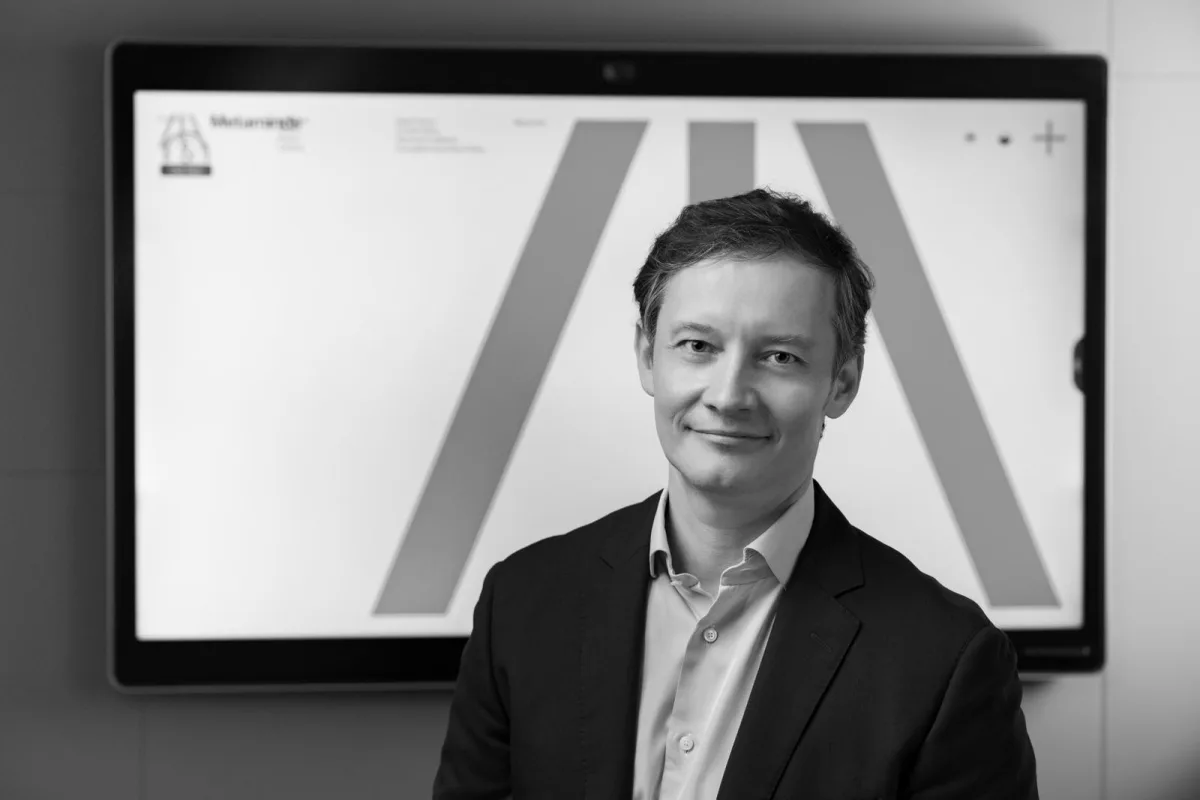
Metaminds is entering a new stage of development, marked by a carefully planned transition. Andrei Cruceru, co-founder and former CEO, is taking on a non-executive role, focusing on the strategic development of the business, while Ovidiu Ghiman returns to a key executive position, with the goal of accelerating the operational transformation and strengthening Metaminds' position as an essential partner in Romania's digitalization. In a dialogue about vision, priorities and challenges, the two leaders speak openly about long-term strategy, the role of technology in modernizing public services and how organizational culture remains a pillar of innovation.
Mr. Cruceru, how do you see this leadership transition and your role in the coming period?
Andrei Cruceru: Founding Member of Metaminds, former CEO
Two years ago, together with Ovidiu and the other partners in the company, we initiated a strategic transformation process, with the clear objective of creating sustainable value both for our clients and for us, as shareholders of Metaminds. This transformation process is a long-term one, structured across several stages, and its central principle is that each phase requires the involvement of the right people in the right roles.
For the next period of this journey, all of us partners believe that Ovidiu is the most suited to take on an executive role, through which he can contribute directly to the operational development of the company. At the same time, I will continue to support the strategic direction of the business from a non-executive position, focusing on business development initiatives. It is, essentially, a transition of roles that we have confidence in and that we believe will bring added value to all parties involved.
Andrei Cruceru, former CEO and co-founder of Metaminds, will continue to play an active role in the company, focusing on the long-term development of Metaminds' projects and vision.
Mr. Ghiman, you are returning to an executive position. What vision do you have for the company's next stage of development, and what are the immediate priorities?
My vision is aligned with that of all the partners within the company, a vision shaped collaboratively over the course of 2024. We aim to build a company with a real impact on the everyday lives of citizens, through technology solutions that support Romania's digital transformation. Our objective is to contribute actively to building a coherent digital ecosystem, in which services are interconnected and accessible, thereby simplifying citizens' interaction with the digital environment.
We have a well-defined growth strategy and a solid foundation, built on the technical expertise of the Metaminds team - over 50 highly qualified engineers. In the coming period, our priority is the rapid and rigorous implementation of this strategy, so that we make the most efficient use of internal resources and market opportunities.
To achieve our objectives, we will continue to invest in expanding our technical capabilities, in strengthening the management team and in increasing the visibility of the Metaminds brand - a brand we want to be synonymous with innovation, performance and excellence in technology.
We firmly believe that success will depend on our ability to maintain clarity and discipline in execution, but also on our strong organizational culture, which supports every step in the strategic direction we have taken on.
In your opinion, what are the most important barriers slowing the pace of digitalization in the public sector?
I identify two major challenges in accessing and truly capitalizing on digital transformation opportunities:
- The speed of absorption of European funds, which is closely tied to rigor in execution and the level of competence of those involved in the process. Without disciplined execution, opportunities remain merely on paper.
- The absence of a mechanism for transferring know-how between the private sector and the public sector. Romania has access to solid expertise in private tech companies - what is missing is a constant process of consultation and collaboration to bring real value to state projects.
When the public and private sectors collaborate effectively, the impact is immediately visible:
- Digital services become more accessible, easier to use and more relevant to citizens, which increases the adoption rate and reduces regional disparities;
- The use of shared resources and the sharing of risks, by leveraging the capabilities and expertise of the private sector, which optimizes costs and reduces implementation risks;
- Access to state-of-the-art technologies and the skills associated with them, which ensures the relevance and sustainability of the implemented systems over the long term.
- As for the strategic directions in which we are focusing: on innovation, applied research and the development of scalable tech solutions. We align ourselves with the accelerated evolution in areas such as artificial intelligence, data management and cloud-native architectures - fields in which we have already delivered projects with concrete impact, such as observability solutions or agile digital infrastructures.
- At the same time, we consider several directions essential to the success of any digital strategy: digital identity, cloud-native platforms, public services built around the real needs of citizens, and digital governance capacity - all inspired, among other things, by successful models at the European level. These are the pillars we are actively investing in, to support real and lasting progress in Romania's digital transformation.
In your opinion, what are the biggest challenges and the biggest opportunities for Metaminds in the coming years?
Human capital is the most valuable resource of any organization, and for Metaminds the potential of our team is, without a doubt, the greatest strategic opportunity in the years ahead. We have the privilege of working alongside exceptionally well-prepared professionals, and our objective is to create a framework that stimulates their individual development and, implicitly, amplifies the company's performance.
One of the main challenges remains attracting new colleagues who not only have a high level of competence but also resonate with our values and ambitions. In parallel, the speed at which digital transformation processes are evolving - both in the public and the private sector - demands constant adaptability and agility from us.
It is well known that Romania ranks among the lowest in the rankings drawn up in the State of the Digital Age Report on digital transformation among European Union member states. This context shows us how much room for progress we have and how critical it is to accelerate strategic decisions in this direction. If we manage to raise awareness of the real impact of digitalization - one done meaningfully, for the benefit of the end user - then the opportunity to contribute significantly to the modernization of society is a truly major one.
How will you strengthen the management team to support the company's ambitious objectives in the coming period?
To support the ambitious objectives we have for the coming period, we will strengthen the management team through a structured approach adapted to the company's current stage of development. We are guided by an essential principle: the right person in the right place, according to organizational maturity and the strategic direction in which we are evolving. This means both attracting leaders with relevant experience and internally repositioning colleagues who have growth potential and alignment with the new business priorities. The impact will be seen in decision-making agility, execution coherence and increased delivery capacity.
In parallel, we invest constantly in developing human capital management capabilities - from operational leadership, to a feedback culture, to performance and talent management. We are building structures that support autonomy, clarity of objectives and ownership within teams, which will amplify both internal efficiency and the achievement of the strategic objectives we have.
Not least, we ensure that the expansion of the management team fully reflects the organizational culture we have built in recent years. We want leaders who not only understand the Metaminds vision but actively live it and propagate it through their own example. This cultural alignment is essential for maintaining decision-making balance and for supporting a common direction.
What do you consider to be the main digital transformation opportunities with significant impact in the public sector?
I believe that Romania has major digital transformation opportunities ahead of it with significant impact on society, especially in essential areas such as: education, health and public finances.
In particular, technology must take a central place in the education system if we want to prepare new generations for the professions of the future and, at the same time, raise the general level of digital skills among the population. These objectives are indispensable for building a solid foundation to support the growth of Romania's economic competitiveness.
In the area of education, there are several concrete directions in which technology can generate real impact:
- Ensuring broad and equitable access to education for all students, thereby helping to reduce the gaps between urban and rural environments;
- Personalizing educational content, adapted to the needs and pace of each student, in order to develop digital skills and prepare for the jobs of the future;
- Using real-time data to inform public policies in education - from analyzing performance differences between students and monitoring absenteeism, to evaluating the impact of investments.
These are just a few examples of how digitalization, applied with meaning and vision, can contribute directly to the sustainable transformation of essential public systems.
Technology has the potential to contribute significantly to increasing life expectancy and improving its quality, through the modernization and streamlining of the health system.
Among the directions with concrete impact are:
- Expanding access to medical services through telemedicine solutions, which can considerably reduce inequalities in access, especially in rural or isolated areas;
- Grounding and adjusting public health policies on the basis of data collected in real time, which allows a rapid and informed response to the population's needs;
- Improving the accuracy of diagnosis and significantly reducing the costs and the time needed to establish it, through the use of technologies based on artificial intelligence, such as the automatic interpretation of medical images.
By capitalizing on these opportunities, technology can become an essential pillar in creating a health system that is more equitable, more efficient and more oriented toward the patient.
Digital innovation is an essential accelerator for increasing the efficiency with which the state manages its public finances. In particular, in the area of tax administration, digitalization can generate a significant impact, with direct benefits for the public budget and for taxpayers' trust. Digitalizing tax administration is not just a logical step but an essential condition for the modernization and sustainability of the public financial system. Among the concrete benefits are:
- Increasing the level of tax compliance, with a direct effect on the volume of taxes collected and on the stability of public revenues;
- Access to real-time data on financial flows, which allows better budgetary planning and can help reduce the costs associated with financing the deficits in the economy;
- Reducing the phenomenon of tax evasion through the use of advanced technologies for fraud analysis and detection;
- Simplifying administrative processes, with positive effects on the productivity of public institutions and on the level of trust that the private sector and citizens have in their relationship with the state.
How do you see Metaminds' role in Romania's digital transformation and in raising digital security standards, in both the public and the private sector?
Metaminds has the expertise and structure needed to contribute substantially to Romania's digital transformation. We have a team of exceptional specialists, with a rigorous approach both strategically and technologically.
The solutions we have proposed and will continue to propose are designed to bring real efficiency and constantly pursue increasing the technical and economic efficiency of business processes.
In my vision, the final objective is clear: to improve citizens' interaction with public services and, at the same time, to raise the level of cybersecurity and resilience.
From my perspective, these elements are essential for modernizing the way in which citizens interact with public services. In a market where the degree of digitalization is still low, Metaminds' capabilities in designing and implementing innovative solutions become an important differentiator. These will certainly play an essential role in our contribution to the process of Romania's digital transformation in the years to come.
How do you intend to manage the Metaminds organizational culture and continue the spirit of innovation that has brought the company to a leadership position?
In 2024, at the shareholder level, we considered a strategic intervention on the organizational culture to be essential. We chose to collaborate with Adrian Florea and the Trend Consult team in a realignment process, which brought a significant amount of additional clarity to our strategic direction. This effort aimed to define fundamental aspects - from mission, vision and strategic directions, to the clear definition of the behaviors we want to encourage, as well as those we want to discourage across the entire organization.
Among the essential behaviors identified are supporting bold initiatives and encouraging open dialogue. These are fully in harmony with the professional profile of the Metaminds team and contribute directly to cultivating an environment that stimulates technological innovation. Building on this solid foundation, the new leadership stage will maintain consistency with the values and organizational culture that define us. In this context, we are confident that our direction will continue to generate relevant and effective solutions for the increasingly complex challenges of digital transformation - in both the public and the private sector.