
Every morning, Romania wakes up to a race against time. The main factor driving congestion in Bucharest and other major Romanian cities is a severely deficient road, rail, and logistics infrastructure. Aging bridges, undersized roads, too few motorways, and weak connections to county roads create a structural bottleneck that inevitably generates gridlock. Digitalization can accelerate mobility, but it cannot compensate for the absence of a solid infrastructure base. This fragile foundation makes any modern technology solution meant to support transport difficult to implement efficiently.
Bucharest is the living image of a city growing faster than it can breathe. For years, the capital has ranked among Europe’s most congested cities, and residents feel it acutely. Time lost in traffic is no longer just a statistic—it has become a defining element of everyday life: less time for family, more stress, higher costs for companies—all translating into a city that moves slowly. Extremely slowly.
Every morning, hundreds of thousands of cars circulate simultaneously in the capital—both from Bucharest and from neighboring counties. Even if there is no official figure for the number of vehicles on the road during peak hours, we all experience the daily pressure of traffic. “Over the past ten years, the number of registered cars in Bucharest has increased by over 40%, reaching more than 1.7 million vehicles today. Added to this are approximately 300,000 cars from neighboring counties every day. The city was not designed for such volume […]” said Stelian Bujduveanu, interim Mayor of Bucharest (source). With an infrastructure that is already fragile, undersized, and unable to absorb such high traffic flows, roads inevitably become the stage for a daily battle over a few extra minutes gained.
In Bucharest, the frantic rhythm of honking, frayed nerves, and bumper-to-bumper traffic feels almost… natural. It’s an image we have become so used to that we rarely look up and ask: is there really no solution?
And yet, the answer is right in front of us. Just as smartphones changed the way we communicate, digitalization has the power to change the way Romania moves. We are at a pivotal moment in digital transformation, yet data remains scattered across institutions, common information-sharing standards are missing, and interoperability is low. On top of this, physical infrastructure limitations amplify these challenges and slow down technological progress.
In a country where transport generates approximately 9.7% of GDP (according to an International Finance Corporation report) and a significant share of carbon emissions, the digitalization of transport becomes a strategic necessity.
While many European countries already operate on digitally connected transport networks, Romania is still building the foundation. And where infrastructure does exist, it is often outdated, fragmented, or poorly integrated into modern European corridors. This reality makes it clear: transport digitalization cannot work in isolation. It requires solid infrastructure, coherence, and responsible funding to become truly effective.
Bucharest: A City Under Pressure
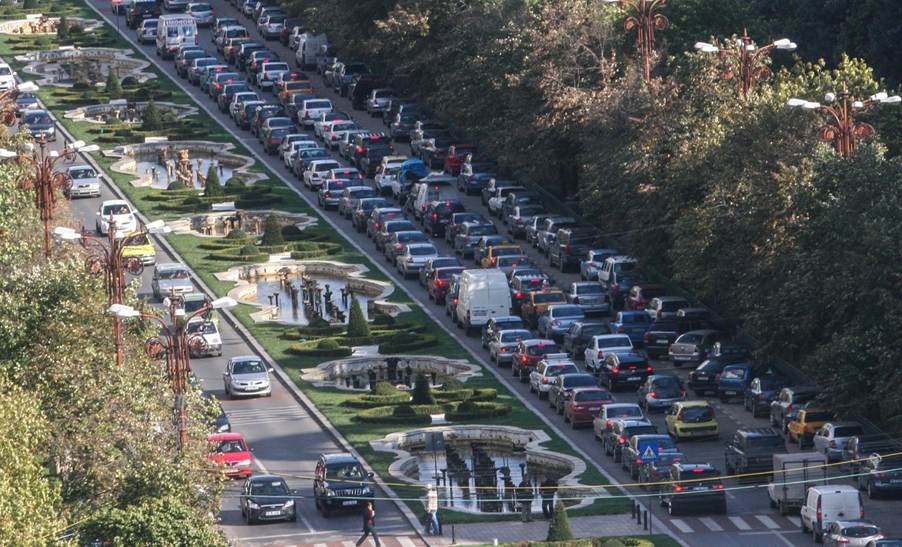
Unfortunately, Bucharest is a perfect case study of an imperfect problem. Over the past two decades, authorities have tried to respond with traditional measures: one-way systems, new underpasses, additional traffic lights, wider boulevards. Yet each isolated intervention has only shifted congestion from one part of the city to another—like a game of Tetris where pieces are placed without strategy and empty spaces disappear only temporarily. Overloaded streets, endless traffic jams, and frustrated honking have become part of an urban ritual that repeats itself without end.
The situation is even more visible in the current electoral context, when urban mobility inevitably returns to the center of public debate. Traffic remains one of the top concerns for residents, and the moment highlights the need for long-term solutions that go beyond political cycles.
And yet, Bucharest is not a city without solutions. It is a city without integration.
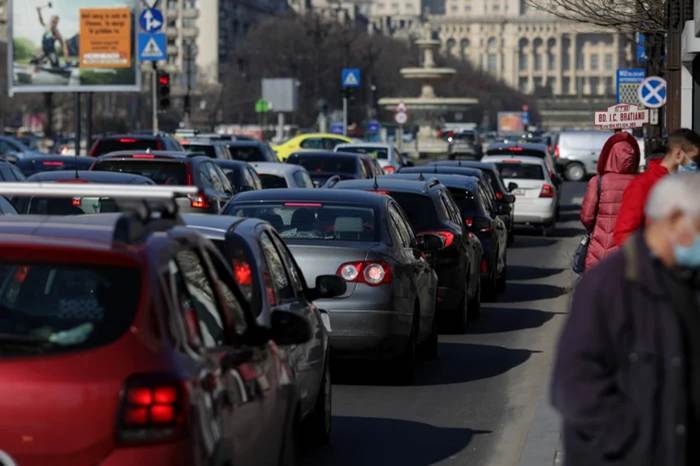
Paradoxically, the capital already has part of the infrastructure required for a smart city: some intersections are equipped with modern sensors, traffic lights can be centrally managed, public transport routes are digitally monitored, and mobility apps are increasingly used. We have an airport capable of handling more than 16 million passengers annually (source), a major rail hub, an essential metro system, a significant inland waterway node, and rapid access to the Danube through nearby ports.
But all these elements are like musical instruments on the same stage playing without a conductor. Each system works—but separately. Road transport does not communicate with rail, buses don’t “know” where bottlenecks are forming, traffic lights do not anticipate traffic flows, the airport is not integrated into the urban mobility network, and data collected by different institutions remains trapped in silos that never meet.
The real barrier is not the absence of technology, but the lack of genuine connectivity between the city’s systems. Without an infrastructure capable of integrating and using this data coherently, Bucharest remains a prisoner of its own bottlenecks. Investments in infrastructure—both physical and digital—are the key that can unlock the technological resources already in place and give the capital a chance to breathe again.
What Authorities Should Consider
-
Intelligent traffic management systems, based on sensors, cameras, and algorithms that automatically adapt traffic-light timing to real-time conditions.
-
A national transport data platform, connecting road, rail, maritime, and air transport information in one place—fuel for algorithms that predict bottlenecks before they occur.
-
Fully digitalized public transport, with synchronized schedules, integrated ticketing, and accurate arrival predictions, so it becomes a credible alternative—not a last resort.
-
Smart freight corridors, eliminating kilometer-long queues at port entrances and weighing stations.
- Automated real-time notification systems for roadworks, detours, and accidents, rerouting traffic flows before congestion becomes gridlock.
How Much Money Does Romania Lose Because of Traffic? Far More Than We Think.
Traffic is not only frustration, stress, and wasted time. Behind every kilometer of tailback lies massive economic loss—losses Romania feels, but often does not measure correctly.
With nearly 10% of GDP generated by the transport sector, Romania is an economy deeply dependent on mobility. Traffic bottlenecks are, at their core, a financial problem—one that directly affects national performance, corporate competitiveness, and employees’ quality of life. What does this look like in practice?
Commuters lose time, companies lose productivity
Travelers are not just people stuck in traffic—they are employees arriving late to the office, teachers arriving late to class, doctors arriving late to appointments. Time lost in traffic is time lost for the entire economy. For Bucharest residents, hours spent in congestion mean roughly 13 working days lost per year for each employee.
Company deliveries become a gamble
When a courier vehicle gets stuck in a Bucharest traffic jam, it doesn’t affect only the end customer. The entire logistics network is disrupted: deliveries slip, orders are rescheduled, and costs rise across the chain—from fleets and warehouses to fuel consumption and staffing. In an economy where e-commerce is growing rapidly, every hour lost in traffic means real money lost.
Supply chains become unpredictable
Freight transport companies face a constant challenge: they cannot accurately estimate when trucks will reach their destination. Repeated delays impact international partnerships, contracts, and even Romania’s reputation as a regional logistics hub. A truck blocked on Bucharest’s ring road or in congestion toward the Port of Constanța means delays along the entire European route.
Carriers pay the bill directly
For road transport businesses, traffic is a measurable accounting loss. Diesel burns while wheels don’t move. Drivers must be paid even when stuck in a queue. Vehicle wear increases, driving times extend, and the number of daily trips decreases. This is where tens—perhaps hundreds—of millions of euros are lost every year.
The Port of Constanța and Otopeni Airport lose competitiveness
The Port of Constanța could be one of Eastern Europe’s most important commercial gateways. But if trucks reach it slowly, if there is no digital coordination, and if routes remain unpredictable, competitiveness is lost in traffic.
The same applies to Otopeni Airport: a modern airport surrounded by one of the most congested road areas in the country. If passengers struggle to get there and air freight is slowed, the economy pays the price.
In the Modern Economy, Time Is Currency—and Traffic Steals It.
Time is the most valuable currency we have—an invisible but powerful asset we invest moment by moment in work, creativity, family, and the projects we build.
Traffic—with its lost hours and paralyzed streets—is a silent thief. It steals from this precious currency every day, without giving anything back. Each traffic jam is not just frustration; it is a real economic loss: employees arriving late, delayed deliveries, postponed decisions, missed opportunities.
By contrast, every minute regained in traffic can immediately be converted into something valuable: productivity, for companies that can achieve more with the same number of people; profit, for businesses that stop losing money on the road; innovation, for entrepreneurs who have time to create instead of sitting in queues.
Synchronizing urban and digital mobility is not only a strong technological exercise—it is also a direct driver of economic growth. When a city functions efficiently, its economy wins in productivity and investment attractiveness. Smooth traffic means on-time deliveries, lower costs, and new opportunities. Predictable mobility makes a city more competitive.
How Much Could We Save If Traffic Became Fluid?
According to recent analyses, Romania could save hundreds of millions of euros annually by modernizing transport infrastructure and adopting measures that reduce operational waste—from lower fuel consumption and the elimination of idle time through route optimization, to more efficient logistics chains and reduced emissions. A smarter approach to mobility, backed by investment in roads, railways, and digital traffic management systems, could radically transform transport costs and quality across the country.
And these are only the direct benefits. The indirect benefits are even more valuable.
What Can Technology Do to Unclog the Roads?
Traffic lights that adapt in real time to traffic flow, buses that receive intersection priority, apps that don’t just display traffic but anticipate it—these are not future concepts. They are available technologies that can be implemented in Romania now.
A national transport data platform as a “digital brain”
Today, each institution holds a piece of the picture: CNAIR for road traffic, Metrorex in separate datasets, CFR for rail, TAROM and AACR for air, port administrations for their own flows. Unifying this information into a common platform would enable route coordination across road, rail, maritime, and air transport; timetable synchronization; real-time freight management; automated truck rerouting; and a national alerting platform for drivers, navigation apps, and emergency services.
Full digitalization of public transport
Real-time displays in stations, integrated travel payment apps, accurate arrival predictions, and a single intermodal ticketing system would turn public transport into a predictable and efficient alternative. In Bucharest, much of the infrastructure exists, but systems are fragmented; integrating them could significantly relieve road traffic.
Smart freight corridors
Freight transport is a major contributor to daily congestion. Trucks stuck in cities or on unprepared ring roads generate major economic losses. Digitalization can help through automated port-access scheduling (Constanța, Giurgiu) to avoid queues, real-time truck monitoring and rerouting, weigh-in-motion sensors, and smarter coordination between ports, airports, and rail hubs.
Marius Marinescu, Managing Partner at Metaminds and specialist in technology solutions for digital services:
“It’s essential to understand that digitalization cannot work in a vacuum. We can build intelligent systems, deploy sensors, algorithms, modern platforms—but all of these need infrastructure capable of supporting them. If a city cannot absorb the physical flow of traffic, technology can only compensate at the margins, not at the core. In reality, the problem is not the lack of technology, but the lack of interconnection between critical infrastructures. Digitalization can accelerate Romania, but only if it is built on a solid foundation.”
Digital transformation in transport would not only ease congestion—it would also create a new market for analytics and prediction platforms, urban mobility applications, route-optimization solutions, and smart logistics startups. It would also open economic opportunities for MaaS (Mobility as a Service)—a single app, a single payment method, and automatically combined routes—as well as for IoT technologies, such as: traffic lights that detect queue length and adjust timings automatically; buses that transmit exact location and estimated arrival; parking sensors that indicate available spaces; traffic monitoring devices that count vehicles and detect congestion.
Romania could thus become a technology producer, not just a consumer—with direct impact on investment, jobs, and know-how exports.
A Romania Where Cities No Longer Stand Still
Romania does not need decades to solve traffic—it needs a coherent strategy that combines digitalization with real investment in infrastructure. The solutions already exist: mature, tested, accessible technologies. What is missing is connecting them into a national smart mobility ecosystem.
Bucharest and other major cities could become modern, efficient centers where time is no longer lost in traffic but redirected to innovation, productivity, and personal life. Traffic is not only stress and wasted hours—it also generates real costs for public health and state budgets. Pollution from congestion increases pressure on the healthcare system, while cleaner air means healthier people and lower public spending. At the same time, smoother and better-monitored traffic means fewer accidents, fewer emergency interventions, and significantly lower social impact.
Where traffic is blocked, development is blocked too. But when mobility is designed intelligently and supported by the right infrastructure, economic potential is unlocked. Cleaner environments and efficient traffic are not just signs of modern cities—they are strategic investments that protect people, save public money, and improve quality of life. Because mobility is not only about getting somewhere faster; it is about enabling an entire country to move forward at the pace it deserves.