
With over two decades of experience in financial management, Ramona Bâliș, Chief Financial Officer and Board Member at Metaminds, has built a solid professional journey across diverse industries, covering key sectors of the economy: IT & Telecommunications, energy, oil & gas, automotive, and international industrial manufacturing. She has designed complex financial structures and demonstrated that, in a world governed by numbers, vision and strategic rigor can go hand in hand.
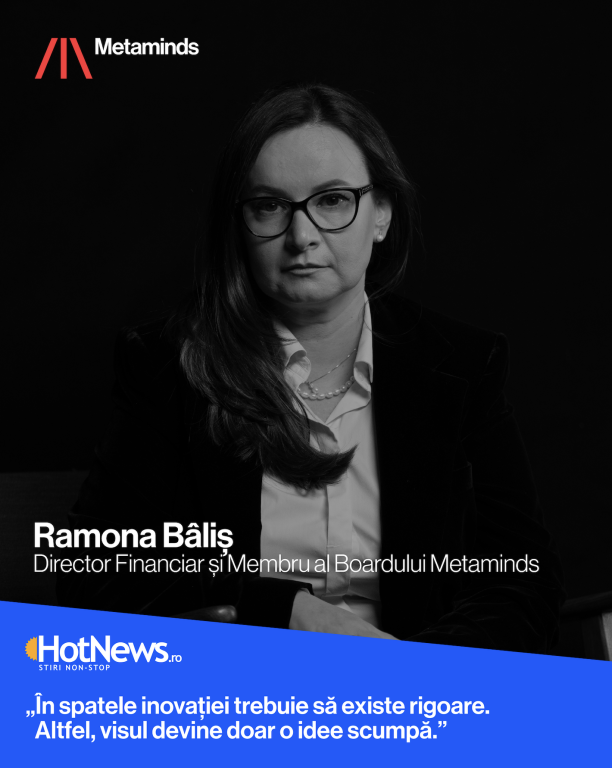
At Metaminds, where innovation is a core commitment embodied in the concept of “Engineering Tomorrow”, Ramona Bâliș explores the courage behind financial decision-making, the power of authentic leadership in technology, and the way trust becomes the foundation of transformation in a world shaped by continuous change. In a context defined by accelerated transformation, the early stages of a professional journey form the basis for understanding today’s leadership vision.
How did your journey into the technology sector begin? Was it a calculated decision or one shaped by the context of the moment?
Throughout my career, I have carefully chosen the companies I evolved alongside—organizations distinguished by high standards of excellence, innovative vision, and the courage to open new paths within their industries.
Today, digitalization and the finance function are more closely connected than ever, especially in Romania’s current context, where authorities impose new reporting and compliance requirements. The role of the CFO is no longer limited to managing numbers, but to strategically integrating technological transformation so that financial processes become more efficient, transparent, and sustainable.
For companies, these changes create real pressure across the entire finance function—from reporting and controlling to cash flow management and taxation—but also for entrepreneurs, who must bear additional costs for systems, consulting, and adaptation. The effort is significant. However, viewed from a medium- to long-term perspective, these investments will pave the way for rapid access to clear data, real-time reporting, and more fluid communication with public institutions, partners, and, last but not least, stakeholders.
Did you have female role models who inspired your career, or did you build your own leadership style step by step through professional experience?
I did not have a specific female role model, but I have always been inspired by competent, authentic, and consistent people around me. Every professional experience helped shape my leadership style organically over time—through observation, curiosity, accountability, and sometimes through mistakes.
For me, leadership is not a fixed formula, but a continuous process of learning and adaptation to context, teams, and values. My style has been shaped around three essential pillars: clarity, trust, and collaboration. In a field such as technology, where change is constant and financial decisions carry continuous pressure, I believe a leader must be more than a numbers analyst—they must be an active partner in building business strategy, capable of combining rigor with vision.
Metaminds builds its strategic direction around “Engineering Tomorrow” and longevity. How do these concepts translate into concrete financial strategies and decisions?
New technologies and modern financial systems can significantly increase operational efficiency and provide critical insights for strategic decision-making. I continuously assess and implement such solutions to stimulate financial growth and support the company’s sustainable transformation.
For me, “Engineering Tomorrow” and longevity translate financially into future-oriented choices, not just short-term results. This means investing in robust technologies, people, and strategic partnerships, even when returns are not immediate. From a financial perspective, these principles mean supporting innovation without compromising balance: building flexible budgets, prioritizing projects with real long-term impact, and maintaining a healthy cost structure capable of supporting both growth and continuous adaptation.
Financial longevity implies decisions that protect the company’s strategic capital—human, technological, and reputational—while cultivating long-term financial health.
How can digitalization, supported by well-prepared teams, transform the finance function into a true engine of decision-making and performance?
Digitalization cannot be sustainably implemented without a strong team built on trust, collaboration, and a culture of continuous learning. This is not only about accounting teams, but about the entire finance function—one capable of connecting data to decisions and transforming information into value.
A well-prepared team aligned with the company’s vision is essential for turning challenges into concrete, long-term solutions. It is the engine that drives strategy forward and enables real-time adaptation to complex change.
Thus, digitalization is not merely an obligation, but an opportunity to reposition the finance function as a driver of decision-making and growth. Sustainability comes from this balanced approach: technology with purpose, efficiency with meaning, and processes that free people from repetitive tasks so they can focus on what truly creates value.
In a field often perceived as “male-dominated,” how have you experienced your presence as a woman in technology? Obstacle, challenge, or unexpected advantage?
I have never felt that technology is “a man’s domain.” I strongly believe leadership is not about gender, but about clarity, empathy, courage, and the ability to build around a shared vision. In technology—as in any field—what matters is what you bring as a professional: how you rally people around a clear direction and move forward, even when the path becomes difficult.
I believe in balance, collaboration, and the strength of a professionally grounded feminine presence. For me, being a woman in this field has been neither an obstacle nor an advantage, but a natural reality in which I have grown step by step, with confidence in what I can build.
Of course, in an environment historically dominated by male figures, there may be an initial perception bias. I never viewed this as an obstacle, but as additional motivation to demonstrate—through results and actions—that professional value is not about labels, but real contribution to the business.
At the same time, I believe women should not give up their femininity to be taken seriously in leadership roles. On the contrary—attributes often considered “feminine,” such as empathy, elegance, patience, intuition, and emotional intelligence, can become powerful leadership assets. There is no need to imitate masculine models to have authority; authenticity and balance are far more powerful.
Elegance, redefined within a business context, can be seen as emotional intelligence and conscious presence—deeply relevant for contemporary female leadership. True power lies not in domination, but in inspiration. Embraced femininity, lived with balance and authenticity, can become a real force for transformation in a constantly evolving business environment.
The role of a CFO in a technology company goes beyond numbers—it requires vision. What are the main challenges in a space where innovation, long-term projections, and risk coexist?
The CFO role requires a deep understanding of financial processes, as well as the ability to analyze and interpret data in a dynamic context shaped by legislative and regulatory change. Today’s economic environment is constantly shifting, and only close attention to executional detail combined with sustained financial growth can make the difference between success and failure.
In this context, the CFO plays a vital role in building bridges between operational needs, external requirements, and business objectives—becoming a catalyst for transformation. Digitalization should not be seen as a purely technical process, but as a strategy of balance: intelligent, phased, with carefully planned costs and a clear focus on measurable outcomes.
Today’s CFO is no longer just a guardian of numbers, but a strategic partner, capable of turning data into decisions and complexity into clarity.
In a world where technology evolves faster than economic models, how do you, as a CFO, make strategic decisions?
In an environment where technology advances faster than economic models can keep pace, the CFO role has fundamentally changed. It is no longer about “keeping the budget under control,” but about being a strategic partner who can look beyond the numbers and anticipate change.
As a CFO, you constantly ask yourself: which technologies can reshape our business model? Which investments bring flexibility and scalability, not just short-term efficiency? Decisions are no longer based solely on past performance, but on scenario-building, real-time data interpretation, and market dynamics understanding.
Everything revolves around adaptability—how to create financial resilience without losing sight of innovation. In a world where change is the only constant, the modern CFO becomes the bridge between stability and progress, and collaboration with technical teams is essential. You cannot decide alone whether a platform is worth the investment—you must understand the value it brings and how quickly it can become a real competitive advantage.
In an ecosystem dominated by engineers, IT architects, and innovators, how do you make your voice heard in discussions about numbers and strategy?
I believe in leadership grounded in clarity, trust, and consistency—especially in such a dynamic field as technology. I value direct relationships, encourage initiative, and focus on long-term thinking.
Leadership is not about speaking louder, but about building trust. A voice is heard when it brings solutions, not just problems. To truly be heard, you must first learn to listen. Then, through clarity, consistency, and context, articulate viewpoints rooted in reality, supported by data, and communicated with empathy.
In a tech company, the financial role must go beyond number-keeping—it must be a strategic partnership, involved in growth direction, investment evaluation, and decision sustainability. I take responsibility for decisions, while valuing collaboration and transparency.
How do you maintain the balance between vision and financial rigor, ensuring innovation is supported by bold yet sustainable long-term decisions?
Every stage of my journey reinforced my belief that finance must be deeply connected to vision—because without vision, numbers only reflect the past. The balance between vision and rigor, innovation and sustainability, lies in constant alignment between strategic direction and financial reality. Vision without rigor remains an idea; rigor without vision blocks progress.
In a technology company, where innovation is the main engine, financial sustainability does not mean excessive caution, but the ability to prioritize and sustain development pace without compromising long-term health. It requires bold yet well-founded decisions, smart investments, and a culture that integrates financial responsibility into everything we build.
In financial management—and management overall—it is important not to confuse activity with real progress. Balance means focusing on strategic projects that deliver long-term value, not just tasks that keep us busy without meaningful impact.
We see more women in leadership roles in technology, but fewer in top financial positions. How do you interpret this evolution, and what is still missing?
The business world, traditionally male-dominated, is undergoing profound transformation. Female leadership—also in technology—has brought greater balance, empathy, and diversity of perspectives that enrich decision-making and strategic culture.
Digitalization has created new opportunities for women in technical fields, yet in finance, cultural barriers, closed leadership networks, and outdated perceptions of financial authority persist. These paradigms must change. We need real trust and support from stakeholders, investors, and executive teams to recognize that financial leadership has no gender—competence, vision, and integrity matter.
While we see progress in technology leadership, female representation in financial leadership roles such as CFO or Board Member remains globally modest.
What has your experience as CFO taught you about people and trust—two key resources for company growth?
People and trust are the most valuable organizational resources. Throughout my career, I have learned that without a committed team and a culture based on respect and transparency, even the best financial strategy fails.
At Metaminds, I emphasize team development and performance, as well as a culture of continuous learning. I support professional growth across all departments, because collective intelligence is built only in open, collaborative environments.
Clear objectives, constructive feedback, and recognition of individual contributions lead to high-performing, cohesive teams. As a CFO coordinating large teams and building departments from scratch, I have learned that financial leadership means transparency, respect, and collaboration.
How do you define authentic leadership?
Authentic leadership begins with genuine listening. When leadership listens, strategies become sustainable, organizations become financially smarter, and risks are managed—not feared. Long-term value is built through conscious decisions, balance, and respect for people and financial truth.
Strong companies are not built solely on brilliant ideas, but on leadership teams that understand and respect economic reality—even when it requires adjustment. Clarity creates space for healthy, sustainable growth. Ultimately, leadership is not about numbers, but about people and the ability to turn challenges into real growth opportunities.
What advice would you give young women who want to build a career in technology or finance but fear it is “not their field”?
First and foremost: have courage. Courage to start, to make mistakes, to ask questions, and to keep going. No one starts from perfection, but everyone can grow through curiosity, perseverance, and openness.
I would encourage them to commit sincerely to what they do and see every challenge as a learning opportunity. Technology and finance may seem intimidating at first, but they are fields of performance, where competence and passion truly matter.
This belief is why I wanted to be involved in Meta-Pro, a program developed by Metaminds for students—one that goes beyond theory and offers a clear perspective on the entire business journey, from idea and strategy to decision, execution, and impact. Early exposure to business reality can make the difference between fear and confidence, hesitation and ownership.
I often resonate with this quote:
“If you are not willing to learn, no one can help you. If you are determined to learn, no one can stop you.”
Continuous learning and determination are the most valuable career resources. In a constantly changing world, the ability to learn quickly and adapt becomes a strategic advantage. One final practical piece of advice: seek mentors—people who inspire, guide, and challenge you. Don’t be afraid to ask for feedback or step outside your comfort zone. Real growth does not happen in comfort, but where you dare to test your limits and learn from every step.